
Understanding Field Sobriety Tests in California DUI Cases
If you are stopped on suspicion of DUI in California, an officer may request that you exit your vehicle and perform a series of physical and mental tests.
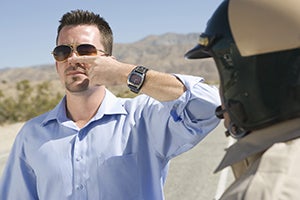
These are referred to as Field Sobriety Tests (FSTs).
Although police officers often rely on these tests to justify arrests, many drivers in California are unaware that they are entirely voluntary.
Knowing how these tests function, their limitations, and your legal rights can help prevent wrongful DUI convictions.
If you were arrested for driving under the influence, the Esfandi Law Group can help you.
Schedule your free consultation at (310) 274-6529 or use the contact form here.
What Are Field Sobriety Tests (FSTs)?
Field sobriety tests are roadside assessments that measure a driver's coordination, balance, and mental function, which includes processing information and following instructions.
Police officers depend on your performance in these tests to determine if they should arrest you for breaking California Vehicle Code 23152 VC.
DUI field sobriety testing is generally broken down into two distinct categories: standardized and non-standardized.
Standardized Field Sobriety Tests (SFSTs)
The National Highway Traffic Safety Administration (NHTSA) identifies and approves three tests as standard measures of impairment.
NHTSA states that, when properly administered, these tests can detect a blood alcohol concentration (BAC) of 0.08% or higher with an accuracy of 79% to 88%.
-
Horizontal Gaze Nystagmus (HGN): The officer slowly moves an object—such as a pen, finger, or flashlight—in front of your face to check your eyes for involuntary jerking (nystagmus), which can be intensified by alcohol or certain drugs.
-
Walk-and-Turn: A "divided attention" test involves walking nine steps heel-to-toe along a straight line, performing a specific turn, then walking nine steps back while counting aloud.
-
One-Leg Stand: Balance on one foot with the other foot about six inches above the ground. Focus on your foot and count aloud until instructed to stop.
Non-Standardized Field Sobriety Tests
Certain agencies rely on alternative testing methods that are very subjective and lack scientific validation from NHTSA. These include:
-
The Romberg Balance Test: Standing with your feet together, tilting your head back, closing your eyes, and estimating when 30 seconds have passed.
-
The Finger-to-Nose Test: Keeping your eyes closed and head still while attempting to bring your index finger directly to the tip of your nose.
-
The Hand-Pat Test: Patting one hand against the other while alternating between the palm and the back of the hand, counting aloud.
-
The Finger Count Test: Touching your thumb sequentially to your index, middle, ring, and pinky fingers while counting forward and backward for three complete sets.
Why Even Sober Drivers Can Fail Field Sobriety Tests
Many drivers agree to roadside tests believing that their sobriety will ensure they pass. However, FSTs are very challenging to perform under stress, and even sober individuals often fail due to external factors.
-
Environmental and Road Conditions: Uneven asphalt, loose gravel, flashing police lights, passing traffic, wind, and inadequate roadside lighting can all disturb anyone's balance.
-
Physical and Medical Conditions: Inner ear problems, vertigo, injuries to the back or knees, arthritis, neurological conditions, and obesity all naturally affect an individual's coordination and balance.
-
Inappropriate Footwear or Clothing: High heels, heavy boots, flip-flops, and restrictive clothing significantly hinder physical performance.
-
Officer Administration Errors: If the officer does not provide clear instructions, mistakes your nervousness for impairment, or overlooks your physical limitations, the outcomes can be affected.
-
Inherent Officer Bias: In many traffic stops, officers may have already decided to make an arrest. FSTs are often employed just to gather evidence to justify that decision, prompting critics to contend that these tests are inherently designed to fail.
Can You Legally Refuse a Field Sobriety Test in California?
Yes. You have an absolute legal right to politely refuse to take field sobriety tests in California.
Since these roadside exercises are voluntary, you cannot be penalized, fined, or charged with a crime just for refusing to perform them. Choosing not to participate removes the prosecution's basis for subjective visual evidence (like swaying, stumbling, or confusion) that could be used against you in court.
The Critical Distinction: Roadside Tests vs. Implied Consent
It's essential to distinguish between voluntary roadside tests and compulsory chemical tests:
Implied Consent Rule: You have the option to refuse voluntary FSTs, such as the roadside Preliminary Alcohol Screening breath test, unless you are under 21 or on DUI probation. However, you are required to take a post-arrest evidentiary chemical test.
If you are formally arrested for DUI in California, you are required by implied consent law to undergo a breath or blood test. Refusing this test after arrest can lead to serious penalties, such as a mandatory one-year license suspension and increased sentencing if found guilty.
Common California DUI Charges
If law enforcement finds probable cause, with or without FST evidence, you could be prosecuted under various sections of the California Vehicle Code.
|
Vehicle Code Section |
Description of Offense |
| VC 23152(a) | Driving under the influence of alcohol (impaired driving, regardless of BAC) |
| VC 23152(b) | Driving with a blood alcohol concentration (BAC) of 0.08% or higher |
| VC 23152(f) | Driving under the influence of drugs (DUID), including prescription or legal substances |
| VC 23140 | Underage DUI (operating a vehicle as a driver under the age of 21 with a BAC of 0.05% or higher) |
Frequently Asked Questions
Will the police arrest me if I refuse to do the field sobriety tests?
An officer might still arrest you if they have other evidence of impairment, like slurred speech, watery eyes, alcohol odor, or erratic driving. However, refusing the FSTs prevents the prosecution from having video or written proof of you stumbling or failing coordination tests, which could be used as evidence against you in court.
Can I refuse the handheld breathalyzer at the scene of the traffic stop?
Yes, if you are over 21 and not on DUI probation, the roadside Preliminary Alcohol Screening (PAS) breath test is entirely voluntary, similar to a Field Sobriety Test (FST). You may politely decline. Remember, this is separate from the official breath or blood test administered after a lawful arrest.
What if the officer didn't tell me that the field sobriety tests were optional?
California law does not mandate police officers to inform you that FSTs are voluntary. Usually, they phrase the request as a command or part of the stop, such as "Step out of the car so I can see how you balance." Even if they do not explicitly inform you of your right to refuse, you still legally have the option to decline.
How long do field sobriety test results remain on my record?
FST results do not serve as a permanent independent record like a conviction or traffic ticket. Instead, they are documented in the police arrest report and included as evidence in your active criminal court case and your California Department of Motor Vehicles (DMV) administrative per se hearing.
Can a non-standardized test be used to convict me?
Non-standardized tests, such as touching your nose or reciting the alphabet, hold little significance on their own due to lack of scientific support. Nonetheless, prosecutors may still present your performance in these tests to suggest to a jury that you appeared or sounded impaired. An experienced defense attorney can challenge or reduce the importance of these subjective exercises in court.
Do I have the right to speak to an attorney before deciding to take an FST?
In California, you do not have the right to consult a defense lawyer before deciding whether to submit to roadside sobriety tests or chemical tests after arrest. Asking to speak to an attorney prior to answering or taking these tests can be legally seen as a refusal by the police, leading to serious administrative penalties. You must make this decision yourself at the scene.
How an Experienced DUI Lawyer Challenges FST Evidence
If you participated in roadside testing and did not perform well, a dedicated defense attorney can systematically challenge the prosecution's FST evidence during your defense.
-
Cross-Examining Officer Training: Review whether the officer was appropriately certified to conduct the specific tests and if they followed the NHTSA protocols precisely.
-
Introducing Alternative Explanations: Providing medical records, details of podiatric conditions, or physical baseline evidence that clarify your issues with balance or coordination.
-
Analyzing Dashcam and Bodycam Footage: Using police video recordings to demonstrate that your speech was clear, your movements were steady, and the roadside conditions were unfavorable or unsuitable for testing.
If you or a loved one are facing DUI charges in California, it's essential to understand police testing procedures, which can be complex. Seek guidance from a qualified criminal defense attorney at the Esfandi Law Group to arrange a thorough case review.