
Health and Safety Code 11370.6: Possession of Drug Money
For decades, the possession, distribution, and sale of large amounts of illegal drugs have had a harmful impact on citizens across California.
Most drug arrests only involve a street dealer or user, making it typically difficult for law enforcement to find and arrest the people who actually run large-scale drug operations.
In an effort to effectively prosecute the individuals who organize and operate these illegal drug operations, the California legislature passed specific laws making it a crime to have possession of drug proceeds.
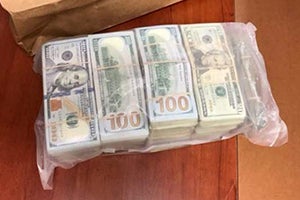
Under California Health & Safety Code 11370.6, it is a severe drug crime to possess over $100,000 that came from the proceeds of drug sales, or to possess over $100,000 intended to purchase illegal drugs.
If you or a loved one is facing allegations under this statute, understanding the law, its penalties, and how a prosecutor builds a case is critical to your defense.
The Esfandi Law Group can help you. Schedule your free consultation at (310) 274-6529.
Defining Health & Safety Code 11370.6
Health and Safety Code Section 11370.6 defines the California criminal offense of possessing drug proceeds or “drug money”.
Legally speaking, the statute applies to anyone who possesses money or negotiable instruments in excess of $100,000 which were obtained from the unlawful sale, possession for sale, transportation, manufacture, or offer for sale of any controlled substance, with knowledge that the moneys were so obtained.
Additionally, it applies to anyone who possesses that same amount of money with the intent to unlawfully purchase any controlled substance.
What Counts as "Money"?
The law does not just apply to physical cash. Under Section 11370.6, "negotiable instruments" are also included, which encompass:
-
Currency (cash)
-
Stocks
-
Bonds
-
Commercial paper
The Purpose of the Law
Several different types of conduct are encompassed in Section 11370.6's terms, but the overall purpose of the statute is to criminalize the large amounts of cash inherently associated with the illicit drug trade.
There will, of course, be cases where law enforcement is unable to arrest a drug buyer or seller dealing in large quantities of narcotics with the actual drugs in hand.
However, if law enforcement intercepts the money used to buy or sell those drugs, Health and Safety Code Section 11370.6 allows the government to seek harsh felony sentences anyway.
By targeting both the proceeds of a sale and the money intended for a purchase, the statute effectively targets both sides of a major drug transaction.
What Must the Prosecutor Prove?
In order for a defendant to be convicted of HS 11370.6, there are crucial elements of the crime that the prosecution must satisfy and prove beyond a reasonable doubt:
-
Possession of Funds: The defendant was in actual possession of money or negotiable instruments totaling more than $100,000.
-
Illicit Source or Intent: The money was acquired from manufacturing, transporting, selling, or possessing a controlled substance, OR it was explicitly intended to purchase a controlled substance.
-
Knowledge: The government bears the strict burden of proving that the defendant knew the money was associated with the drug trade or derived from illicit drug activities.
Factors Used to Prove Guilt
Because people often have innocent or lawful explanations for holding large amounts of cash, the law does not automatically criminalize possessing more than $100,000. Instead, the section is strictly directed at individuals with provable connections to drug activity.
To bolster their case, judges and juries are guided by several factors presented by the government, including:
-
Lack of Gainful Employment: A lack of legitimate employment or income that would otherwise provide a reasonable explanation for having $100,000+ in cash.
-
Expert Testimony: Testimony from a qualified controlled substances expert regarding the likely source or destination of the money.
-
Ledgers and Pay/Owe Sheets: Documents, digital ledgers, or "pay/owe sheets" indicating active drug sales or distribution activity connected to the defendant.
-
Additional Evidence: Evidence of prior drug transactions, controlled buys, or testimony from undercovers and cooperating witnesses.
Related Offenses
Charges under HS 11370.6 are rarely filed in isolation. They are commonly accompanied by other state or federal charges, including:
-
HS 11351 / HS 11378 (Possession for Sale): Charged if illegal substances are found alongside the currency, indicating an active sales operation.
-
HS 11352 / HS 11379 (Transportation or Sale): Charged if the individual is stopped while actively moving drugs or money between locations.
-
PC 186.10 (Money Laundering): Charged if there is evidence of an attempt to conduct financial transactions through a bank or business to disguise the illicit origin of the funds.
California Health & Safety Code 11365 HS declares that it is a misdemeanor to knowingly be present at the scene where certain controlled substances are unlawfully used if you also aid, assist, or encourage that drug activity.
California Health and Safety Code 11355 prohibits offering, arranging, or agreeing to sell, furnish, transport, administer, or give a controlled substance, especially when delivering a counterfeit drug or fake version.
California Health and Safety Code 11370.9 makes it a crime to knowingly handle drug proceeds with intent to hide their source, ownership, location, or control, known as money laundering involving drug sales.
Penalties for HS 11370.6
Health and Safety Code Section 11370.6 is a “wobbler” under California law. This means the District Attorney's office has the discretion to review the arrest and choose to prosecute the offense as either a misdemeanor or a felony.
The consequences vary severely depending on how the crime is filed:
|
Charge Level |
Maximum Potential Punishment |
| Misdemeanor |
Up to one year in a county jail |
| Felony |
Two, three, or four years in California state prison |
Fighting Possession of Drug Money Charges
Facing an HS 11370.6 charge can be incredibly stressful, but an experienced California criminal defense lawyer can evaluate the facts of your case to build a strong defense.
The Criminal Defense Attorney Exception
Section 11370.6 includes a very specific rule regarding defense attorneys who receive legal fees to represent clients during drug case investigations or prosecutions.
While criminal defense lawyers may indirectly come into possession of drug proceeds through these fees, prosecuting them automatically would severely interfere with a defendant's Sixth Amendment constitutional right to counsel.
To protect this right, the statute requires the government to provide additional proof if they attempt to prosecute a defense attorney.
They must prove the attorney had the explicit intent to participate in the unlawful narcotics conduct or actively intended to disguise the illicit source of the money (i.e., money laundering).
Legal Strategies and Pre-Filing Intervention
For standard defendants, a skilled attorney can work to protect your rights and bring your case to a successful resolution by leveraging several strategies:
-
Pre-Filing Intervention: By intervening immediately after an arrest but before charges are formally filed, a defense attorney may be able to present mitigating evidence to the District Attorney, successfully influencing them to file a misdemeanor rather than a felony, or to avoid the formal filing of charges altogether.
-
Negotiating Reduced Charges: If charges are already filed, your legal team can negotiate with the prosecutor for reduced charges or even a total case dismissal, depending on the evidence.
-
Demonstrating a Legal Source: Proving that the funds came from a legitimate source, inheritance, or legal business transaction to sever the prosecutor's claimed connection to drug activity.
Frequently Asked Questions
Can I be charged under HS 11370.6 if the money came from a completely legal source?
Yes. Health and Safety Code Section 11370.6 makes it a crime to hold money intended to purchase illegal drugs, even if the money you are holding originally came from a completely legitimate, legal source. The intent to use the money for an illegal drug transaction is what triggers the violation.
What is the difference between a misdemeanor and a felony conviction under this law?
The primary difference lies in the sentencing. A misdemeanor filing carries a maximum penalty of 1 year in county jail. A felony conviction is much more severe, carrying a potential state prison sentence of 2, 3, or 4 years.
How does the prosecution prove I knew the money was from drug sales?
The prosecution will consider the circumstances surrounding your arrest. They often rely on circumstantial evidence such as the presence of drug ledgers (pay/owe sheets), a lack of regular, gainful employment to explain the large sum of cash, statements from cooperating witnesses, or evidence of prior controlled buys.
Where can I find the official jury instructions for this crime?
For more technical legal information regarding how juries evaluate these charges, you can look at the California Criminal Jury Instructions: CALCRIM 2430 (possession of drug proceeds) and CALCRIM 2431 (money intended for purchase).
Contact an Experienced California Drug Crime Attorney
If you or a family member has been charged under California Health and Safety Code Section 11370.6, fast action is essential to protecting your future.
Contact the experienced criminal defense team at Esfandi Law Group today to schedule a comprehensive case consultation. We will advise you on the best legal steps to take based on the unique circumstances of your situation.