
California Miranda Rights Violations
What Happens If Police Fail to Read Your Rights?
Miranda rights are a critical part of the criminal justice system in California and across the United States. These rights protect individuals from self-incrimination during police interrogations and ensure access to legal counsel.
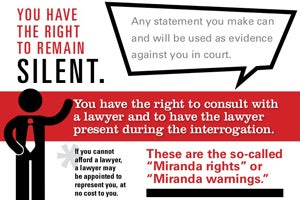
If law enforcement fails to properly advise you of your Miranda rights before custodial interrogation, statements you make may be excluded from evidence in court.
A Miranda rights violation occurs when police question a person who is in custody without first informing them of their constitutional rights, including the right to remain silent and the right to an attorney.
If this happens, your statements may be suppressed and cannot be used against you in court.
For the best chance at a positive outcome, consider reaching out to an experienced California criminal defense attorney at Esfandi Law Group.
We're here to help—call us for a free consultation at (310) 274-6529 or contact us online whenever you're ready.
What Are Miranda Rights?
Miranda rights are constitutional protections that law enforcement must explain to a person before conducting a custodial interrogation.
These rights are designed to prevent self-incrimination and ensure that individuals understand their legal protections when questioned by police.
Miranda rights come from the 1966 U.S. Supreme Court decision Miranda v. Arizona, which established that suspects must be informed of their rights before being interrogated while in custody.
In California, the difference between detention and arrest is one of the most crucial in criminal law. While both involve police interaction, they differ significantly in terms of authority, legal basis, and outcomes.
Knowing your constitutional rights during police questioning helps safeguard against self-incrimination, false confessions, illegal searches, and unnecessary criminal charges.
The core Miranda rights include
- The right to remain silent
- The warning that anything you say can be used against you in court
- The right to have an attorney present during questioning
- The right to a court-appointed attorney if you cannot afford one
Why Miranda rights matter
These rights protect individuals from being pressured or coerced into making statements that could be used against them. They also ensure that any waiver of rights is made knowingly and voluntarily.
If law enforcement fails to properly advise you of these rights before custodial interrogation, your statements may be excluded from evidence in court.
When Miranda rights apply
Miranda warnings are required only when:
- You are in custody (not free to leave), and
- Police are asking questions intended to produce incriminating responses
If both conditions are not present, Miranda warnings may not be required.
Key Takeaway
Miranda rights are essential legal protections that ensure you understand your right to remain silent and your right to an attorney before police questioning. They apply specifically during custodial interrogation and play a critical role in protecting your constitutional rights.
When Must Police Read Miranda Rights?
Police are required to read Miranda rights only when two specific legal conditions are present simultaneously: custody and interrogation. If either element is missing, Miranda warnings are generally not required.
The two required conditions
Custody
You are considered in custody when a reasonable person in your situation would believe they are not free to leave. This typically includes formal arrest, handcuffing, or being held in a police station.
Interrogation
Interrogation refers to direct questioning or law enforcement actions that are reasonably likely to elicit an incriminating response.
When Miranda warnings are required
Miranda rights must be read when:
- You are under arrest or otherwise in custody, and
- Police begin asking questions related to a suspected crime
When Miranda warnings are not required
Police do not have to read Miranda rights in situations such as:
- Routine traffic stops or brief detentions
- Voluntary conversations where you are free to leave
- Questions that are not designed to produce incriminating answers
- Situations where no interrogation takes place
Example scenarios
Example 1
You are arrested and questioned at a police station about a crime. Miranda warnings are required.
Example 2
You are pulled over for speeding and asked basic questions. Miranda warnings are not required because you are not in custody.
Example 3
You are free to speak with officers and leave at any time. Miranda warnings are not required.
Important legal insight
Even if police fail to read your Miranda rights when required, it does not automatically invalidate your arrest. Instead, it may prevent your statements from being used as evidence in court.
Key Takeaway
Police must read Miranda rights only before custodial interrogation, not simply at the time of arrest. Understanding this distinction is critical when evaluating whether your rights were violated.
Common Misconception: Do Police Have to Read Your Rights at Arrest?
No. Police are not required to read Miranda rights at the moment of arrest. The requirement applies only before custodial interrogation begins.
If police arrest you but do not question you, they do not need to read your rights.
How Miranda Rights Can Be Violated
Miranda violations can occur in several ways.
Failure to give warnings
Police question a suspect in custody without reading Miranda rights.
Ignoring the request for an attorney
If you ask for a lawyer, questioning must stop. Continuing to question you violates your rights.
Coercion or improper tactics
Confessions obtained through threats, pressure, or manipulation may be invalid.
Continuing questioning after invoking silence
If you clearly state that you want to remain silent, the police must stop questioning.
What Happens If Your Miranda Rights Are Violated?
The primary consequence is suppression of evidence.
Statements may be excluded
Any statements obtained in violation of Miranda cannot be used against you in court.
Evidence derived from statements may be challenged
In some cases, evidence obtained through unlawful questioning may also be excluded.
Charges are not automatically dismissed
A Miranda violation does not automatically result in dismissal of charges. Prosecutors may still rely on other evidence.
What Is a Miranda Waiver?
Key Elements of a Valid Waiver
| Element | What It Means | Why It Matters | Example |
|---|---|---|---|
|
Knowing |
You understand your Miranda rights after they are explained |
Ensures you are aware of your right to remain silent and request an attorney |
Officer reads rights and asks if you understand them |
|
Intelligent |
You comprehend the consequences of giving up those rights |
Confirms you understand that your statements can be used against you |
You acknowledge that speaking may be used in court |
|
Voluntary |
You choose to speak without coercion, threats, or pressure |
Protects against forced or manipulated confessions |
You agree to answer questions without intimidation |
|
Express Waiver |
You clearly state or sign that you agree to speak |
Creates clear evidence that you waived your rights |
Signing a written waiver form |
|
Implied Waiver |
You begin answering questions after understanding your rights |
Courts may infer waiver from your actions |
Nodding yes and answering questions without objection |
Key Takeaways
- A Miranda waiver means you give up your right to remain silent and your right to an attorney during questioning
- The waiver must be knowing, intelligent, and voluntary to be valid
- You can stop answering questions at any time, even after waiving your rights
- If the waiver is invalid, your statements may be suppressed in court
What If You Were Questioned Without a Miranda Warning?
If law enforcement questions you while you are in custody and fails to read your Miranda rights, any statements you make during that interrogation may be excluded from evidence in court.
This is known as suppression of evidence and is one of the primary legal remedies for a Miranda violation.
What happens to your statements
- Statements obtained without proper Miranda warnings are generally inadmissible in the prosecution's case-in-chief
- Prosecutors cannot use those statements to prove your guilt at trial
- Your attorney can file a motion to suppress the statements before trial
What about the evidence discovered from those statements
In some cases, evidence obtained through unlawful questioning may also be challenged. However, courts may allow certain evidence if it can be shown that it would have been discovered independently.
Does a Miranda violation mean your case will be dismissed
Not necessarily. A Miranda violation does not automatically invalidate your arrest or charges. The prosecution may still move forward using:
- Physical evidence
- Witness testimony
- Surveillance or forensic evidence
However, if your statements are a key part of the case, suppressing them can significantly weaken the prosecution's position.
Example scenarios
Example 1
You are arrested and questioned without being read your rights, and you confess. That confession may be excluded from evidence.
Example 2
Police obtain physical evidence unrelated to your statements. That evidence may still be used in court.
Important legal insight
You always have the right to remain silent, even if police do not advise you of your rights. You can refuse to answer questions and request an attorney at any time.
Key Takeaway
If you were questioned without receiving a Miranda warning while in custody, your statements may be suppressed. While this does not automatically end your case, it can play a critical role in your defense strategy.
Can You Still Be Convicted?
Yes. A Miranda violation does not prevent prosecutors from filing charges or pursuing a conviction.
However, if the case relies heavily on statements obtained in violation of your rights, suppression of that evidence can lead to reduced charges or dismissal.
Real-World Examples
Example 1
A suspect is arrested and questioned at a police station without being advised of Miranda rights. Their confession may be excluded from evidence.
Example 2
A person voluntarily speaks to police during a roadside stop and is not in custody. Miranda warnings are not required, and statements may be used.
Example 3
A suspect requests an attorney, but police continue questioning. Any statements obtained afterward may be suppressed.
Related Crimes and Legal Issues
Penal Code 148 – Resisting arrest
Resisting arrest involves interfering with or resisting law enforcement during an arrest or investigation.
Penal Code 69 – Obstructing an officer
Using threats or force to prevent an officer from performing official duties.
Penal Code 422 – Criminal threats
Making criminal threats that cause another person to fear for their safety.
Penal Code 211 – Robbery
Robbery involves taking property from another person by force or fear, often involving custodial interrogation.
Penal Code 187 – Murder
Murder involves homicide cases that frequently involve Miranda issues due to custodial questioning.
Fourth Amendment violations
Fourth Amendment violations involve illegal searches and seizures and may result in the suppression of evidence, similar to Miranda violations.
Key Takeaways
- Miranda rights protect against self-incrimination during police interrogation
- Police must advise you of your rights only during custodial interrogation
- Violations can lead to suppression of statements
- Charges may still proceed even if a violation occurred
- Legal representation is critical to protect your rights
Frequently Asked Questions
Do police have to read Miranda rights when arresting you?
No. They must read your rights only before custodial interrogation.
What happens if police do not read your rights?
Your statements may be excluded from evidence.
Can a case be dismissed due to a Miranda violation?
Not automatically, but it may weaken the prosecution's case significantly.
What is the difference between custody and detention?
Custody means you are not free to leave. Detention is a temporary stop and does not always require Miranda warnings.
Should you talk to the police without a lawyer?
It is generally advisable to speak with an attorney before answering questions.
Speak With a California Criminal Defense Attorney
If you believe your Miranda rights were violated, it is important to act quickly. A criminal defense attorney can evaluate your case, file motions to suppress evidence, and protect your constitutional rights.
Esfandi Law Group is ready to support you. Feel free to schedule your free consultation today!