
In the United States criminal justice system, the judge serves as an impartial mediator and the ultimate authority on the law. Under Article III of the U.S. Constitution, the judicial branch is charged with interpreting the law and ensuring that all legal proceedings adhere to constitutional due process.
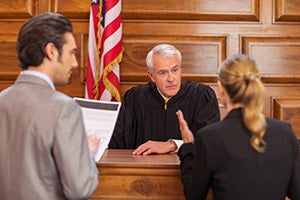
Because the United States uses an adversarial judicial system, criminal cases are presented as contests between two opposing sides: the prosecution (representing "the People") and the defense (representing the accused).
The judge remains neutral throughout this process, acting as an objective "referee" to ensure fairness, rule on legal issues, and uphold the defendant's constitutional rights.
What Does a Judge Do in a Criminal Case?
A criminal court judge performs five core functions during a trial:
-
Manages Court Proceedings: Sets schedules, hears pretrial motions, manages dockets, and ensures proper courtroom decorum.
-
Enforces Due Process (Acts as Referee): Rules on objections, determines the admissibility of evidence, and protects the defendant's 6th Amendment right to a fair trial.
-
Acts as the Trier of Fact (in Bench Trials): Evaluates witness credibility, determines proven facts, and issues the verdict when no jury is present.
-
Instructs the Jury (in Jury Trials): Supervises jury selection, provides binding instructions on how to apply the law, and orders the jury to disregard inadmissible evidence.
-
Determines and Imposes Sentences: Pronounces statutory penalties, fines, probation terms, or prison sentences following a guilty verdict or plea.
Key Duties of a Criminal Court Judge
Managing Courtroom Proceedings and Calendars
The judge oversees the administration of criminal cases from arraignment to final disposition.
While court clerks handle administrative notices and calendar maintenance, the judge retains ultimate responsibility for court scheduling, hearing pretrial motions, and managing jury panels. This oversight guarantees that proceedings move efficiently without violating the defendant's right to a speedy trial.
Acting as an Impartial Referee and Protecting Due Process
A judge must enforce statutory procedural rules and constitutional guarantees. In criminal trials where penalties include incarceration or probation, an objective referee is critical to protect the civil rights guaranteed by the U.S. Bill of Rights and state constitutions (such as the California Constitution).
If a judge makes procedural or legal errors while refereeing a trial, those mistakes can create grounds for a defense appeal or a mistrial.
Core Roles in an Adversarial Criminal Trial:
-
The Prosecution (District Attorney): Represents "the People," bears the burden of proof, and presents evidence to prove guilt beyond a reasonable doubt.
-
The Defense (Attorney): Represents the accused, advocates for their rights, cross-examines witnesses, and challenges the prosecution's case.
-
The Judge (Impartial Referee): Remains neutral, interprets the law, rules on objections, and enforces constitutional due process for both sides.
Establishing Facts (Bench Trials vs. Jury Trials)
The entity responsible for evaluating evidence and deciding guilt is called the trier of fact:
-
Bench Trial: When a trial proceeds without a jury, the judge acts as both the trier of law and the trier of fact. The judge evaluates witness credibility, weighs physical evidence, and determines whether the prosecution proved guilt beyond a reasonable doubt.
-
Jury Trial: The jury acts as the trier of fact, while the judge remains the sole trier of law.
Guiding and Supervising the Jury
In a jury trial, the judge and jury work together to ensure a fair verdict:
-
Voir Dire: The judge supervises jury selection (voir dire) to identify and eliminate potential juror bias.
-
Evidentiary Rulings: The judge prevents the jury from hearing inadmissible evidence, such as improper hearsay, prejudicial statements, or unlawfully obtained items.
-
Jury Instructions: Before deliberations, the judge issues formal instructions explaining the exact legal definitions of the charged offenses and the legal standards the jury must apply.
Issuing Sentences After Conviction
If a defendant enters a plea of guilty or no contest, or is convicted at trial, the case proceeds to the sentencing phase.
The judge evaluates statutory sentencing guidelines, probation reports, victim impact statements, and arguments from both the prosecutor and defense counsel. While juries determine guilt, the judge almost exclusively calculates and pronounces the final penalty, which may include probation, restitution, community service, or prison time.
Comparison: Role of the Judge in a Bench Trial vs. Jury Trial
While the judge remains the authority on legal rules in every criminal courtroom, their specific responsibilities shift depending on whether the trial takes place with or without a jury.
Responsibilities in a Bench Trial (Judge Only)
In a bench trial, the defendant waives their right to a jury, leaving the judge to handle both legal rules and factual determinations:
-
Interpreting the Law: The judge interprets all applicable statutes, legal precedents, and constitutional protections.
-
Ruling on Evidence & Objections: The judge determines which evidence is legally admissible and rules on objections raised by counsel.
-
Determining Fact & Credibility: The judge acts as the sole trier of fact, deciding which witness statements and physical exhibits are believable.
-
Determining Guilt or Innocence: The judge decides whether the prosecution proved guilt beyond a reasonable doubt and issues the final verdict.
-
Imposing the Sentence: If the defendant is found guilty, the judge calculates and announces the penalty.
Responsibilities in a Jury Trial (Judge & Jury Split)
In a jury trial, duties are divided between the judge (who manages the law) and twelve citizens (who evaluate the facts):
-
Interpreting the Law (Judge): The judge maintains exclusive authority over statutory interpretation and courtroom legal standards.
-
Ruling on Evidence & Objections (Judge): The judge decides what evidence the jury is allowed to see or hear.
-
Determining Fact & Credibility (Jury): The jury evaluates witness credibility and weighs conflicting evidence.
-
Determining Guilt or Innocence (Jury): The jury deliberates privately to deliver a unanimous verdict of guilty or not guilty.
-
Imposing the Sentence (Judge): If the jury returns a guilty verdict, the judge retains exclusive authority to pronounce the final sentence.
Related Offenses & Court Procedures
Understanding a judge's role helps clarify how specific criminal charges and court proceedings unfold:
-
Pretrial Motions & Hearings: Defense attorneys file motions to dismiss charges or suppress evidence directly with the judge before trial begins.
-
Plea Bargain Agreements: While prosecutors and defense counsel negotiate plea deals, the judge must formally review and approve any plea agreement before it becomes legally binding.
-
Felony vs. Misdemeanor Trials: Judges apply procedural rules differently based on the severity of the charge, including setting bail amounts and conditions of release.
-
Post-Conviction Appeals: These appeals focus on whether the trial judge committed legal errors in jury instructions or evidentiary rulings.
Frequently Asked Questions (FAQs)
Who has more power in a criminal court, the judge or the prosecutor?
The judge holds ultimate legal authority in the courtroom. While prosecutors hold sole discretion over which criminal charges to file, the judge controls courtroom proceedings, rules on evidence, approves plea bargains, and determines final sentences.
Can a judge dismiss a criminal case directly?
Yes. A judge can dismiss a criminal case if there is insufficient evidence to support the charges, if the prosecution violated the defendant's constitutional rights (such as the right to a speedy trial), or as a remedy for severe prosecutorial misconduct.
Can a judge override a jury's verdict in a criminal case?
A judge can overturn a jury's guilty verdict and enter a judgment of acquittal if no reasonable jury could have found the defendant guilty based on the evidence presented. However, under the 5th Amendment's Double Jeopardy Clause, a judge can never override a jury's not guilty verdict.
What is the difference between a trier of law and a trier of fact?
The trier of law (always the judge) decides legal questions, such as whether evidence is admissible or what legal definitions apply. The trier of fact (the jury in a jury trial, or the judge in a bench trial) evaluates testimony and physical evidence to decide what actually happened.
How does a judge decide a defendant's sentence?
Judges base sentencing decisions on state or federal statutory guidelines, the severity of the offense, the defendant's prior criminal record, aggravating or mitigating circumstances, and arguments presented by counsel during the sentencing hearing.
Contact an Experienced LA Criminal Defense Lawyer
Navigating a criminal case requires an attorney who understands courtroom procedure, judicial tendencies, and evidentiary rules. If you or a loved one face criminal charges in Southern California, early legal intervention is critical.
Esfandi Law Group
-
Lead Attorney: Seppi Esfandi (Over 20 years of dedicated criminal defense practice in Los Angeles and Southern California)
-
Consultation: Free 24/7 Case Evaluation
-
Phone: 310-274-6529
